
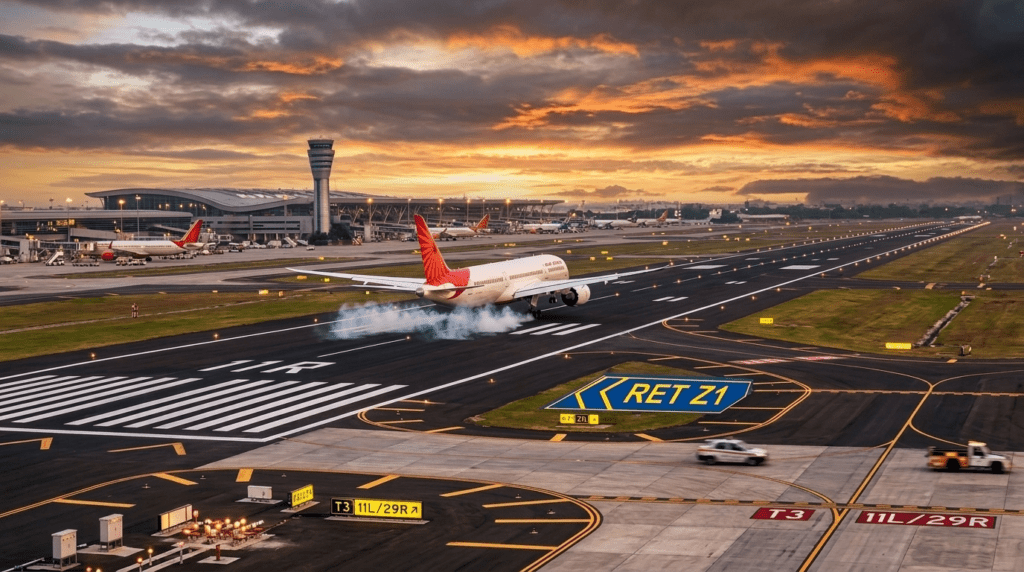
Delhi Airport Third Runway Reopens: Runway 11R/29L Back in Service After 7-Month Rehabilitation
Delhi’s busiest airport has its full four-runway set-up back. Delhi International Airport Limited (DIAL) confirmed that Runway 11R/29L, commonly called the third runway, resumed operations on September 20, 2026, after a comprehensive rehabilitation and all regulatory approvals. The work began in February 2026 and ran for roughly seven months.
The Delhi Airport third runway now returns with new pavement, a new rapid exit taxiway (RET Z1), a permanently displaced 29L threshold and upgraded airfield lighting. It is not a fifth runway. It is an existing runway restored and made more efficient.
Reopening Runway 11R/29L: Key Upgrades Completed During the 7-Month Rehabilitation
The programme included resurfacing, pavement strengthening and a permanent displacement of the Runway 29L threshold. DIAL also built RET Z1 and upgraded the airfield ground lighting (AGL), along with related civil and electrical works.
In plain terms:
Resurfacing and pavement strengthening: a fresh, stronger surface for heavy, frequent landings.
Permanent threshold displacement (29L): the landing threshold on the 29L end has been moved permanently. In general, displaced thresholds are used to keep landing and approach zones clear and safe.
RET Z1: a new angled exit that lets landing aircraft leave the runway sooner.
AGL upgrade: better runway and taxiway lighting, which matters most in low visibility.
DIAL worked with the DGCA, AAI, ATC and airlines, and operations restarted only after inspections, validations and clearances were complete. CEO Pradeep Panicker called the recommissioning a step toward “future-ready aviation infrastructure.”
Why Is 11R/29L Called the Third Runway When Delhi Has Four?
The name is historical. DIAL’s project announcement described 11R/29L as a 4,430-metre runway commissioned in 2008. It was the third runway added to the airport, and the label stuck.
IGI Airport now operates four runways: 09/27, 10/28, 11L/29R and 11R/29L. The fourth runway and the dual Eastern Cross Taxiways went live in July 2023. During the closure, Delhi ran on three runways. The reopening restores the full four-runway configuration.
This runway is also the longest at IGI. It is equipped for Category III instrument landing operations, and it last had minor rehabilitation in 2017. The 2026 project was far more extensive.
How RET Z1 and Resurfacing Boost Delhi Airport’s Hourly Flight Capacity
Runway capacity depends heavily on runway occupancy time (ROT), the time a landing aircraft spends on the runway. Every extra second delays the next arrival or departure.
A rapid exit taxiway is angled so pilots can leave at higher speed instead of slowing to a near stop for a 90-degree turn. DIAL says RET Z1 is designed to let aircraft exit quickly and cut runway occupancy time. Shorter occupancy means tighter spacing between movements and faster turnarounds.
| Parameter | Detail |
|---|---|
| Runway | 11R/29L (third runway, commissioned 2008) |
| Length | 4,430 metres, longest at IGI |
| Closure period | February 2026 to September 20, 2026 (about 7 months) |
| Major upgrades | Resurfacing, pavement strengthening, 29L threshold displacement, RET Z1, AGL upgrade |
| Peak runway capacity (DIAL data) | Up to 86 movements per hour |
| Daily movements (DIAL data) | About 1,514 on average; record of 1,550 |
| Passenger traffic, FY 2025–26 | 73.67 million |
| Capacity roadmap | 106 MPPA now, 116 MPPA by 2030, 125 MPPA by 2032 (targets) |
Note that the 116 and 125 MPPA figures are DIAL’s targets, not current capacity.
Passenger Impact: Reduced Taxi Times and Enhanced Fog Resilience
Passengers won’t see the runway. They will see the effect: fewer aircraft circling, shorter waits on the taxiway and steadier schedules. That is the expectation, not a guarantee. The reopening adds operational flexibility, but it does not promise that every delay will disappear.
Fog is Delhi’s real stress test. Winter mornings cut visibility, and a Category III-equipped runway with upgraded lighting gives ATC more room to keep operations moving. Weather still decides the final outcome, so a single foggy morning is not a fair before-and-after comparison.
Smoother arrivals also mean people reach the curb closer to schedule. If you’re coordinating a pickup, pre-booking a Delhi Airport taxi service lets the driver track your live landing time instead of waiting blind.
What Changes for Arrivals at Terminal 1, 2 and 3
Nothing changes on the terminal side. DIAL’s announcement covered airside works only. Terminal layouts, pickup zones and walking routes stay as they were.
For Terminal 3, the largest terminal, the main practical point is timing. Landing on schedule doesn’t help if you don’t know where your driver waits. The Terminal 3 pickup guide covers pickup points and parking rules, which are worth checking before you fly in. Travellers using T1 or T2 should confirm their terminal on the airline ticket, since flights are allocated by carrier.
DIAL Master Plan 2032: Scaling Capacity From 106M to 125M Passengers
The runway supports a larger goal. Delhi handled 73.67 million passengers in FY 2025–26, against a current capacity of 106 MPPA. DIAL’s roadmap targets 116 MPPA by 2030 and 125 MPPA by 2032.
Runways are only one bottleneck. Terminals, airspace, immigration and ground access all have to keep pace. Reopening 11R/29L removes one constraint, but it does not make the system unlimited.
More traffic also means more people moving on the ground. Travellers planning multi-city trips or longer stays often compare Delhi Airport car rental options before landing, since self-drive and driver-provided rentals both need a confirmed pickup slot.
Who Benefits Most From the Reopening
- Domestic flyers on peak-hour banks: better runway flow helps tight morning and evening schedules.
- International arrivals: long-haul passengers gain most from a smoother landing sequence.
- Winter travellers: improved lighting and Category III capability support low-visibility reliability.
- Business travellers: predictable arrivals make meetings easier to plan. Many pre-arrange chauffeur services at Delhi Airport so a driver is waiting whatever the landing time.
What to Watch After September 20
The real proof comes from data, not announcements. Track these indicators in the coming weeks:
- Average runway occupancy time on 11R/29L.
- Peak-hour movements against the 86-per-hour benchmark.
- Taxi-in and taxi-out times during morning and evening banks.
- On-time performance during the first fog spells.
- New frequencies or slot changes from airlines.
The runway also doesn’t change what you pay after landing. Ground tariffs are separate, so check the current Delhi Airport taxi fare before you book a ride.
Bottom Line
The Delhi Airport third runway is back after seven months, with a stronger surface, a rapid exit taxiway and better lighting. It restores full four-runway operations and supports the push toward 125 MPPA by 2032. Whether delays fall depends on how it performs in real traffic, especially this winter.
If you’re flying into Delhi soon, plan the last mile as carefully as the flight. Delhi Airport Transfer covers rides from all three terminals.
Frequently Asked Questions
When did Delhi Airport's third runway reopen?
Runway 11R/29L reopened on September 20, 2026, after a seven-month rehabilitation that began in February 2026.
How many runways does Delhi Airport have?
IGI Airport has four runways: 09/27, 10/28, 11L/29R and 11R/29L. The reopening restores all four to service.
Why is 11R/29L called the third runway?
It was the third runway commissioned at IGI, in 2008. The name reflects that order, not a count of the airport’s runways.
What is RET Z1?
RET Z1 is a new Rapid Exit Taxiway built on Runway 11R/29L. It lets landing aircraft leave the runway faster, reducing runway occupancy time.
Will the reopening reduce winter fog delays?
It should help, since the runway supports Category III operations and has upgraded lighting. Delays can still occur, and DIAL has not promised otherwise.
What did the rehabilitation cost?
DIAL’s reopening announcement did not disclose the project cost.
What are DIAL's capacity targets?
DIAL’s current capacity is 106 MPPA. Its targets are 116 MPPA by 2030 and 125 MPPA by 2032.
Do pickup zones or terminal procedures change?
DIAL’s announcement covered airside works only. Confirm current pickup arrangements with your airline or DIAL before travel.