
Delhi Airport Terminal Guide (IGI Airport): T1, T2 & T3 Pickup, Parking & Passenger Information
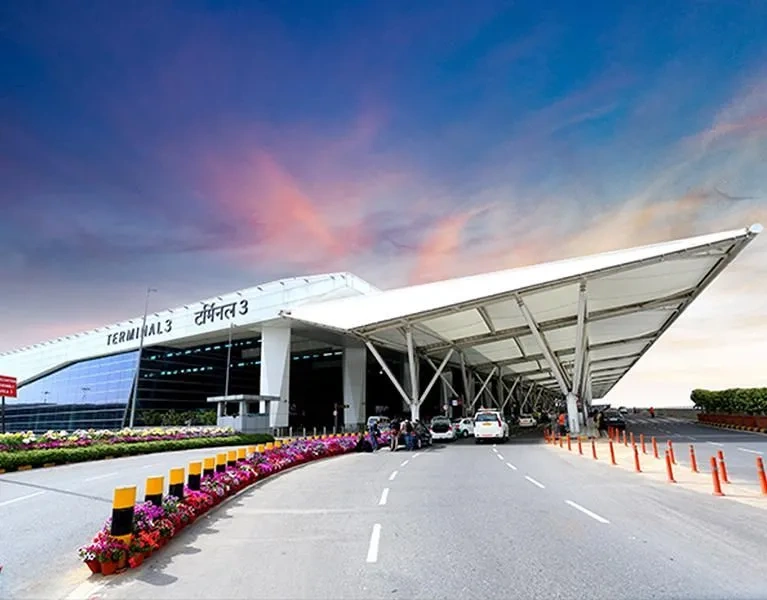
Passengers walking from IGI Airport Terminal 3 arrivals through the enclosed footbridge toward the MLCP parking and pickup zone at Pillars 4–8
Delhi’s Indira Gandhi International (IGI) Airport runs three terminals — T1, T2, and T3 — each handling a different mix of domestic and international traffic. IGI Terminal 3 alone processes over 40 million passengers annually. For arriving passengers across any terminal — particularly those with heavy luggage, family groups, or pre-confirmed ground transport — understanding forecourt rules, parking tariffs, and pickup layout before landing eliminates unnecessary delays and unexpected costs.
This guide covers the complete operational framework for all three terminals: how to find your terminal, parking charges, pedestrian navigation, chauffeur pickup protocols, arrival and departure flow, and terminal-specific regulations.
Quick Answer: T3 Parking Charges & Pickup Rules
Private cars at Delhi Airport Terminal 3 MLCP get the first 12 minutes free. After that, parking is ₹160 for 12–30 minutes, ₹250 for 30 minutes–1 hour, ₹320 for 1–2 hours, ₹500 for 2–4 hours, with a maximum daily charge of ₹600.
Commercial cars are charged from entry: ₹270 for 0–30 minutes, ₹500 for 1–2 hours, ₹700 for 2–4 hours, with a maximum daily charge of ₹800.
| Vehicle | Duration | Charge |
|---|---|---|
| Private Car FREE | 0–12 mins | Free |
| Private Car | 12–30 mins | ₹160 |
| Private Car | 30 mins–1 hour | ₹250 |
| Private Car | 1–2 hours | ₹320 |
| Private Car | 2–4 hours | ₹500 |
| Private Car | Up to 24 hours | ₹600 max |
| Commercial Car | 0–30 mins | ₹270 |
| Commercial Car | 1–2 hours | ₹500 |
| Commercial Car | 2–4 hours | ₹700 |
| Commercial Car | Up to 24 hours | ₹800 max |
Pickup Rule: Do not wait at the T3 arrival curb. Curbside waiting is subject to ANPR enforcement. Pre-booked chauffeur pickups use the MLCP pickup area at Pillars 4–8.
Quick Answer: Which Terminal Do You Need?
- Flying international? You’re at Terminal 3, regardless of airline.
- Flying domestic? Your terminal depends on the airline and specific flight — it could be T1, T2, or T3.
- Terminal assignments change. Airlines periodically reallocate flights between terminals. Always check your boarding pass, booking confirmation, or airline website before travelling rather than assuming based on airline alone.
How to Find Your Terminal Before Travel
Terminal assignments are not fixed by airline — they can shift with schedule changes, seasonal adjustments, or airport reallocation. Confirm your terminal using one of these sources before you leave for the airport:
- Your boarding pass — the terminal is printed alongside your gate and flight details.
- Your booking confirmation email — sent by the airline at the time of ticketing.
- The airline’s official website — search using your PNR or flight number for the latest terminal assignment.
- Airline customer support — a quick call or chat confirms the current terminal if your booking is older or you’re unsure.
- Your flight number — cross-checking it on the airline’s flight status page will show the assigned terminal for that specific day.
Doing this the night before, not at the airport gate, avoids the 20–30 minute cost of discovering you’re at the wrong terminal.
Delhi Airport Terminal Overview
Terminal 1 (T1) is the domestic terminal on the western side of the airport campus, generally used by low-cost domestic carriers.
Terminal 2 (T2) is the other domestic terminal, generally used by full-service domestic operators.
Terminal 3 (T3) is IGI’s flagship facility — the terminal for all international flights, plus a share of domestic traffic. It remains the largest, busiest, and most amenity-rich terminal at the airport, which is why the sections below give it the deepest coverage.
Because airline-to-terminal assignments shift over time, always confirm your specific terminal using the methods above rather than relying on which airline you’re flying.
Delhi Airport Terminal Comparison
| Terminal | Operations | Common Flight Types | Arrival Area | Departure Area | Taxi Pickup | Parking | Key Facilities |
|---|---|---|---|---|---|---|---|
| T1 | Domestic only | Low-cost domestic | T1 arrivals hall | T1 departures | Curbside + prepaid taxi counter | Surface parking, ~50m from arrivals | Self-check-in, food court, Digi Yatra gates |
| T2 | Domestic only | Full-service domestic | T2 arrivals hall | T2 departures | Curbside + prepaid taxi counter | Surface parking, ~50m from arrivals | Standard domestic amenities |
| T3 | International + Domestic | All international, mixed domestic | T3 international/domestic arrivals | T3 departures | MLCP-based, Pillars 4–8 | Multi-Level Car Parking (MLCP) | Duty-free, lounges, valet, Meet & Assist |
Airline-to-terminal assignments change periodically — always verify with your boarding pass rather than this table alone.
Delhi Airport Terminal 1
Overview: T1 is a domestic terminal on the western side of the airport campus, generally handling low-cost domestic operations. It’s compact compared to T3, with a more straightforward layout.
Arrival process: Domestic arrivals proceed from the aerobridge or apron bus directly to baggage reclaim, then exit into the T1 arrivals concourse — no customs or immigration involved, as this is a domestic-only terminal.
Departure process: Check-in counters, self-service kiosks, security, and boarding gates are arranged in a compact layout, with Digi Yatra-enabled entry gates available for faster processing.
Taxi pickup: Curbside pickup is available directly outside the arrivals exit, along with a prepaid taxi counter and app-based cab pickup points.
Parking: Surface parking is located approximately 50 metres from the arrivals exit (rates below).
Passenger navigation: T1’s smaller footprint means shorter walking distances between check-in, security, and gates than at T3.
Practical tip: Security lines can build quickly during peak morning and evening slots given T1’s high-frequency domestic schedule — arrive with extra buffer time, and consider Digi Yatra registration in advance to speed up entry.
Delhi Airport Terminal 2
Overview: T2 is a domestic terminal handling a share of Delhi Airport’s overall domestic traffic, with a compact, single-building layout.
Arrival process: Domestic arrivals move straight from the aircraft to baggage claim and out through the T2 arrivals exit.
Departure process: Standard domestic check-in, baggage drop, security, and boarding — no international processing at this terminal.
Pickup arrangements: Pre-booked chauffeur services, app-based taxis, and private vehicles can collect passengers directly at the T2 curbside.
Parking: Surface parking sits roughly 50 metres from the arrivals area (rates below).
Navigation: T2’s layout is compact and linear, making it easy to move between check-in and gates without excessive backtracking.
Passenger guidance: If you’re connecting between T2 and T3, use the free inter-terminal shuttle rather than exiting and re-entering security — it saves both time and money.
IGI Airport Terminal 3 (T3): Pickup & Parking Guide
The T3 Arrival Forecourt Regulations: Automated Camera Enforcement
The outer arrival forecourt at IGI Terminal 3 operates under continuous 24/7 Automated Number Plate Recognition (ANPR) surveillance, fully integrated with FASTag vehicle identification systems. Drivers are strongly advised not to use arrival lanes for waiting, as continuous ANPR monitoring creates immediate towing risks for vehicles that remain stationary beyond active passenger loading.
Vehicles should not wait or idle at the T3 arrival curb beyond immediate passenger loading. Curbside waiting is subject to ANPR enforcement, so passengers arranging pickups should use the designated parking or pickup facility rather than relying on roadside waiting.
For pre-booked chauffeur pickups, passengers should follow the MLCP route and proceed to the designated pickup area at Pillars 4–8 rather than waiting at the arrival curb. Delhi Airport Transfer operates within this MLCP pickup framework, helping passengers arrange a pre-booked chauffeur pickup away from the T3 arrival curb.
Arrival Process by Terminal
Arrival flow at Delhi Airport follows the same broad sequence at every terminal, with T3 adding an international processing layer.
- T1 & T2 (domestic): Deplane → baggage claim → arrivals exit → pickup or transport.
- T3 (international): Deplane → immigration → baggage claim → customs (green/red channel) → arrivals exit via Gates 1–6 → pickup or transport.
- T3 (domestic): Deplane → baggage claim → arrivals exit → pickup or transport (no immigration/customs).
Transport options at the arrivals exit include curbside taxis, prepaid taxi counters, app-based cabs, and — for T3 specifically — MLCP-based pre-booked chauffeur pickup.
Departure Process by Terminal
- Terminal entry: Security checks your ticket and ID at the terminal entrance before you can access check-in.
- Airline check-in: Use counters or self-service kiosks depending on your airline and terminal.
- Baggage drop: Hand over checked luggage at the designated counter after check-in.
- Security screening: Proceed through the security hold area; T3’s larger scale means multiple lanes but also longer walking distances.
- Boarding: Head to your assigned gate. At T3 specifically, allow 10–15 minutes of walking time, since gates can be spread far apart.
Taxi Pickup Points
Terminal 1 & Terminal 2: Curbside pickup sits directly outside the arrivals exit. Prepaid taxi counters, app-based cab zones, and private vehicle pickup are all accessible within a short walk of the terminal doors. If you’d rather skip the queue entirely, a pre-arranged airport pickup can meet you at the exit with your name confirmed in advance. For a pre-arranged pickup across T1, T2 or T3, see our Delhi Airport Taxi Service for pickup arrangements, vehicle options and booking details.
Terminal 3: Curbside waiting in the forecourt is not viable due to ANPR enforcement (see above). Passengers have three practical options:
- Pre-booked chauffeur services — stage inside the MLCP at Pillars 4–8, away from forecourt restrictions.
- Prepaid airport taxis — available via counters just outside Gates 1–6.
- App-based taxi services — typically use designated pickup zones rather than the immediate curbside; check your app for the current pickup point.
Private vehicles collecting T3 passengers should plan to park in the MLCP rather than idle at the curb, since brief roadside stops beyond passenger loading are subject to towing. If you want to compare the expected cost before booking, see our Delhi Airport Taxi Fare guide for route and vehicle-wise pricing information.
Private vehicles collecting T3 passengers should plan to park in the MLCP rather than idle at the curb, since brief roadside stops beyond passenger loading are subject to towing. To compare estimated taxi fares before booking, see our Delhi Airport Taxi Fare guide for route- and vehicle-wise pricing information.
Getting Between T1, T2 & T3
If you’re connecting flights across terminals, or dropping off and picking up passengers at different terminals, Delhi Airport offers a few ways to move between them:
- Free inter-terminal shuttle — connects all three terminals and is the standard option for transiting passengers.
- Buggy service — available between T2 and T3 for passengers who need assistance or are short on time.
- Cab or taxi — a straightforward option if you’re travelling with luggage or prefer not to wait for the shuttle.
Budget at least 30–45 minutes for an inter-terminal transfer, especially if it involves re-clearing security. If your connecting flight is tight, check with your airline about priority transfer assistance.
Terminal Parking
Visitor Parking Charges at Delhi Airport
Delhi Airport operates 24×7 visitor parking facilities across Terminal 1, Terminal 2, and Terminal 3, with each parking area located a short walking distance from its respective terminal. Charges are structured by vehicle type — private car, commercial car, and two-wheeler — and increase in slabs based on how long the vehicle stays parked.
Terminal 1 Parking Charges
| DURATION | PRIVATE CAR (₹) | COMMERCIAL CAR (₹) |
|---|---|---|
| 0 min – 30 mins | ₹160 | ₹270 |
| 30 mins – 1 hour | ₹250 | ₹400 |
| 1 hour – 2 hours | ₹320 | ₹500 |
| 2 hours – 3 hours | ₹400 | ₹600 |
| 3 hours – 4 hours | ₹500 | ₹700 |
| 4 hours – 24 hours MAX DAILY | ₹600 | ₹800 |
| DURATION | RATE (₹) |
|---|---|
| Up to 30 minutes | ₹30 |
| 30 mins – 2 hours | ₹60 |
| Every subsequent hour (up to 8 hrs) | ₹30 |
| After 8 hours (up to 24 hrs) | ₹300 |
Terminal 2 Parking Charges
| DURATION | PRIVATE CAR (₹) | COMMERCIAL CAR (₹) |
|---|---|---|
| 0 min – 30 mins | ₹160 | ₹270 |
| 30 mins – 1 hour | ₹250 | ₹400 |
| 1 hour – 2 hours | ₹320 | ₹500 |
| 2 hours – 3 hours | ₹400 | ₹600 |
| 3 hours – 4 hours | ₹500 | ₹700 |
| 4 hours – 24 hours MAX DAILY | ₹600 | ₹800 |
| DURATION | RATE (₹) |
|---|---|
| Up to 30 minutes | ₹30 |
| 30 mins – 2 hours | ₹60 |
| Every subsequent hour (up to 8 hrs) | ₹30 |
| After 8 hours (up to 24 hrs) | ₹300 |
Terminal 3 Parking Charges
Visitor parking at Terminal 3 operates through the official Multi-Level Car Parking (MLCP) facility. Private cars receive a complimentary 12-minute window from entry. Commercial cars are charged from entry and do not receive the private-car grace period.
| Duration | Private Car | Commercial Car |
|---|---|---|
| 0–12 minutes FREE | Free | — |
| 12–30 minutes | ₹160 | — |
| 0–30 minutes | — | ₹270 |
| 30 minutes–1 hour | ₹250 | — |
| 1–2 hours | ₹320 | ₹500 |
| 2–4 hours | ₹500 | ₹700 |
| 4–24 hours | ₹600 max | ₹800 max |
Terminal 3 parking is located approximately 50 metres from arrivals. Parking here operates through the official MLCP/visitor parking system, and charges remain subject to revision by the airport authority.
Two-Wheeler Parking Charges at Delhi Airport
If you are travelling to or from Indira Gandhi International (IGI) Airport on a motorcycle or scooter, it is useful to check the two-wheeler parking charges before arriving. Delhi Airport’s official parking page lists the following rates for two-wheelers.
| Parking Duration | Two-Wheeler Parking Fee (₹) |
|---|---|
| Up to 30 minutes | ₹40 |
| 30 minutes to 2 hours | ₹80 |
| Each subsequent hour, up to 8 hours | ₹40 |
| More than 8 hours, up to 24 hours MAX DAILY | ₹400 |
| Lost parking ticket | ₹400 |
Parking tip: If you plan to leave your motorcycle or scooter at the airport while travelling, confirm the applicable parking facility, availability and current tariff before your journey. Parking charges may change, so check the latest rates on the official Delhi Airport parking page.
Avoid T3 Parking & Pickup Hassles
If you are collecting a passenger from Terminal 3, you can avoid parking queues and curbside waiting by booking a private airport taxi in advance.
Delhi Airport Taxi Service — for planned T1, T2 and T3 pickups.
Delhi Airport Taxi Fare — check vehicle and route pricing before booking.
Bus Parking at Delhi Airport
For passengers travelling in a group via a bus, or for bus operators visiting Delhi Airport, dedicated bus parking is available at three locations — the Public Transport Centre (PTC), Terminal 1, and a Premium Bus Parking facility at Terminal 3.
| DURATION | PTC (₹) | TERMINAL 1 (₹) | PREMIUM BUS (T3) (₹) |
|---|---|---|---|
| Up to 30 minutes | ₹200 | ₹200 | ₹1,500 |
| 30 mins – 2 hours | ₹500 | ₹500 | — |
| Every subsequent hour (up to 8 hrs) | ₹250 | ₹250 | — |
Helpful Parking Notes
Parking charges at Delhi Airport are calculated according to the duration slab a vehicle’s stay falls into, with the applicable rate applied at exit. Accepted payment methods are determined by the airport parking operator and may vary by terminal or facility. As tariffs are subject to periodic revision by the airport authority, visitors are advised to verify the latest parking charges before travelling.
Travellers arriving at Delhi Airport who are weighing chauffeur-driven vehicle options can refer to our premium MPV comparison guide to understand differences in luggage capacity, seating configuration, and passenger comfort across MPV categories. It’s a useful reference for families, corporate travellers, and larger groups deciding which vehicle best suits their journey from the terminal. If you need a vehicle beyond a single airport pickup, see our Car Rental in Delhi options for chauffeur-driven and longer-duration travel across Delhi NCR.
Navigation Blueprint: T3 Baggage Reclaim to MLCP Pillars 4–8
The pedestrian route from T3 baggage reclaim to the MLCP chauffeur staging zone covers approximately 400–500 metres through a fully enclosed, climate-controlled walkway. The route is trolley-accessible throughout.
Step 1 — Baggage Reclaim. Collect all checked luggage from the designated carousel inside the T3 Arrivals hall. Verify all bags are accounted for before proceeding toward the exit channels.
Step 2 — Clear Customs & Exit via Gates 1–6. Proceed through the green or red customs channel as applicable. Exit into the main public arrivals concourse via Gates 1–6. This area opens directly into the primary arrivals forecourt.
Step 3 — Bypass Curbside Counters. The area immediately outside Gates 1–6 houses prepaid taxi counters, aggregator pickup signage, and informal transport services. Pre-booked passengers do not require engagement with these counters.
Step 4 — Follow MLCP Signage to Elevated Footbridge. Follow overhead directional boards marked “Car Parking / MLCP”. Take the designated lifts or escalators to access the fully enclosed, air-conditioned elevated footbridge. This structure spans the arrival road and connects directly into the MLCP building. The footbridge is fully enclosed and trolley-compatible.
Step 5 — Enter MLCP & Descend to Pickup Level. After crossing the footbridge, enter the 6-storey MLCP structure. Use the central lifts to descend to the designated chauffeur pickup level.
Step 6 — Rendezvous at Pillars 4–8. The Pillars 4–8 cluster functions as the designated rendezvous point for pre-booked ground transport. Chauffeurs hold position here with printed name placards and coordinate pickup based on confirmed flight arrival details. This area provides a more predictable pickup point away from high-volume app-cab queues and curbside congestion. For passengers who want a confirmed pickup in advance, our Airport Transfer Services provide pre-booked airport pickup and drop-off options.
Passengers who prefer a pre-booked pickup can choose a chauffeur-driven airport transfer with flight tracking, Meet & Greet inside the arrivals hall, and MLCP-compliant pickup at Pillars 4–8. To compare pickup options and booking details, see our Delhi Airport Taxi Service or explore our Airport Transfer Services.
Premium Operational Protocols & Departures Flow
Meet-and-Assist & Buggy Coordination
Passengers with mobility requirements or those anticipating extended immigration processing times can pre-arrange Meet-and-Assist services through their airline or a certified ground handler. Airport buggy escorts track from the aerobridge through immigration, baggage claim, and customs clearance — with the designated handoff point at the MLCP chauffeur bay, Pillars 4–8. Pre-booked transfer operators coordinate pickup timing directly with the buggy escort team on the day of arrival.
Valet Parking — Domestic Arrival Zones
A 24/7 valet parking facility operates at the T3 domestic arrival zone. The service is priced at a flat ₹500 for the first 2 hours, applied over and above the prevailing standard MLCP hourly parking slabs. This charge represents an additional service fee layered on top of existing tariffs — not a discounted parking alternative.
T3 Departures Loop: Operational Compliance
The T3 departures road operates under a strict minimal-idle protocol. Vehicles entering the departures lane are required to complete passenger and luggage offloading immediately and vacate without delay. Extended idling or re-circling within the departures loop is subject to the same ANPR enforcement framework active at the arrivals forecourt.
Passengers requiring a full-day vehicle with chauffeur for pre-departure meetings, sightseeing circuits, or business errands across Delhi NCR can arrange structured bookings through full-day chauffeur rental services, which include MLCP-compliant terminal drop protocols as standard.
Corporate delegations, diplomatic missions, and executive travellers requiring structured point-to-point transfers across Central Delhi, Lutyens’ Bungalow Zone, or Aerocity can access chauffeured car rental services in New Delhi with Forward Charge Mechanism GST invoicing and PSV-badged chauffeurs across all fleet categories.
Helpful Passenger Tips
- Confirm your terminal before you leave home. Terminal assignments can shift between T1, T2, and T3 — a wrong assumption can cost 20–30 minutes on the inter-terminal shuttle.
- Arrive early for T3 departures. Its scale means longer walks between check-in, security, and boarding gates than T1 or T2.
- Follow overhead signage, not instinct. MLCP and parking directions at T3 are clearly marked overhead — trust the signs over guesswork.
- Plan pickup in advance for T3. Curbside waiting isn’t viable under ANPR enforcement; decide between MLCP chauffeur pickup, prepaid taxis, or app-based cabs before landing.
- Understand the parking grace window. T3 private cars get a free 12-minute window; commercial vehicles do not. Factor this into drop-off timing.
- Travel light through the footbridge. The T3 route to MLCP is trolley-accessible but spans 400–500 metres — plan extra time if travelling with a group or heavy luggage.
- Account for peak-hour congestion. Early morning and late evening slots see the heaviest traffic at all three terminals; build in buffer time accordingly.
Frequently Asked Questions
Q1. What are the official car parking charges at IGI Airport Terminal 3 MLCP?
Terminal 3’s MLCP follows a slab-based parking structure rather than a flat hourly tariff. Private cars receive a complimentary 12-minute window from entry, long enough for a genuine drop or pickup, after which charges apply progressively across the published parking slabs as the stay extends. Commercial vehicles do not receive this grace period and are billed from the moment of entry under their own slab structure. The exact rate for each duration is listed in the parking table above — this structure is what determines which slab a given visit falls into.
Q2: Where does a pre-booked private chauffeur wait at IGI Terminal 3?
Pre-booked private chauffeurs wait at the T3 MLCP pickup area at Pillars 4–8. Passengers should follow the Car Parking/MLCP signs, cross the enclosed footbridge, enter the MLCP and proceed to the designated pickup level.
Q3. Why are private cars and commercial vehicles charged differently at the IGI Terminal 3 MLCP?
Private and commercial vehicles have different parking tariffs because of commercial regulations, different parking usage patterns, and commercial fleet fee structures.
Q4: Is there a free waiting window at the IGI T3 curbside for vehicle pickups?
No. The T3 arrival curb is subject to zero-tolerance ANPR enforcement and should not be treated as a free waiting area. The 12-minute free window applies only to private cars inside the MLCP, not to curbside waiting.
Q5. Which terminal handles international flights at Delhi Airport?
All international flights operate from Terminal 3, regardless of airline.
Q6. How do I check my departure terminal?
Check your boarding pass, booking confirmation email, or your airline’s official website. Terminal assignments can change, so verify close to your travel date.
Q7. Which terminal is my airline using?
This varies by airline and even by specific flight, since terminal assignments are periodically reallocated. Always confirm using your boarding pass or airline confirmation rather than assuming based on past experience.
Q8. Where can someone pick me up at Delhi Airport?
Pickup arrangements depend on the terminal. At T1 and T2, passengers can use designated curbside pickup areas and taxi zones. At T3, pre-booked chauffeur pickups should use the MLCP pickup area at Pillars 4–8 rather than waiting at the arrival curb. For a pre-arranged pickup, see our Delhi Airport Taxi Service or Airport Transfer Services.
Q9. Which terminal has MLCP?
Terminal 3 operates the Multi-Level Car Parking (MLCP) facility. Terminals 1 and 2 use surface-level visitor parking instead.
Q10. Is parking available at all terminals?
Yes. All three terminals offer visitor parking — surface parking at T1 and T2, and MLCP parking at T3 — each within roughly 50 metres of the arrivals area.
Q11. Can passengers move between terminals?
Yes. A free inter-terminal shuttle connects the terminals, and buggy or cab transfers are also available, particularly between T2 and T3.
Q12. How early should I arrive at Delhi Airport?
For domestic flights at T1 or T2, arriving 2 hours before departure is generally sufficient. For international flights from T3, arrive at least 3 hours early given the terminal’s scale and additional immigration/security processing.
Q13. Which terminal should I use?
Check your boarding pass. International flights always use T3. Domestic flights use T1, T2, or occasionally T3, depending on your specific airline and flight.
Need a Chauffeur for Your Airport Pickup?
A pre-booked airport transfer helps you avoid curbside waiting and last-minute taxi availability issues. For T3 arrivals, chauffeur pickups can be arranged through the MLCP pickup area at Pillars 4–8, with flight tracking and Meet & Greet options.
Book a Delhi Airport Taxi Service or compare Delhi Airport Taxi Fare before your journey.