Event Transportation Service in Delhi NCR: 2026 Fleet & Logistics Management Guide
A Decision-Maker’s Guide for Event Managers, MICE Planners, and Corporate Procurement Teams
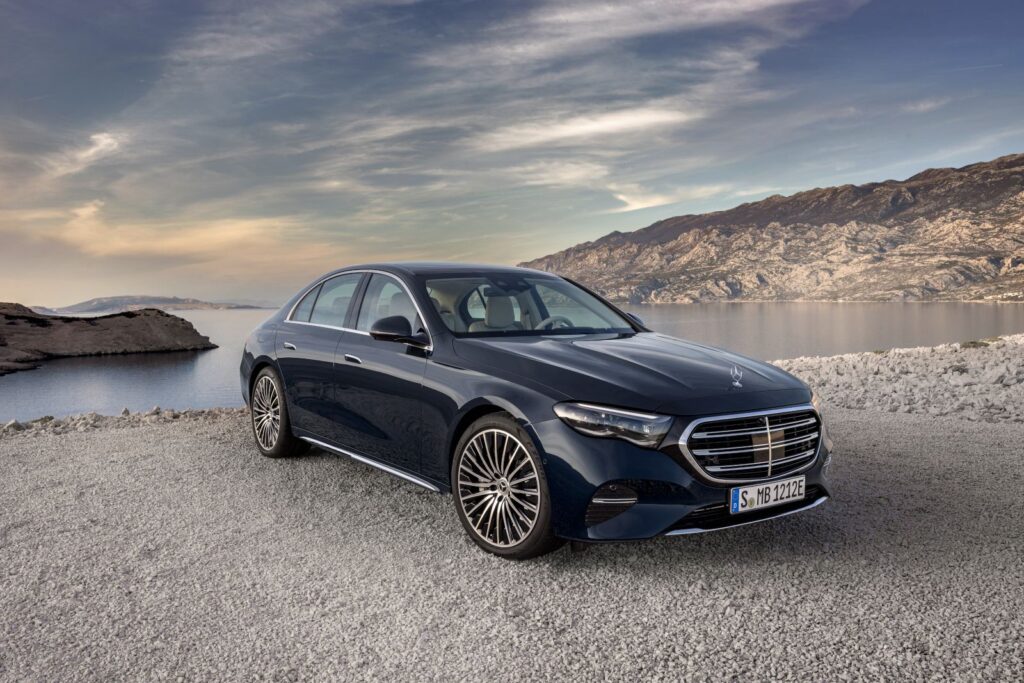
Our Event Transportation Services in Delhi NCR are designed for conferences, corporate events, exhibitions, MICE programs, destination weddings, and VIP movements. We coordinate airport transfers, hotel-to-venue shuttles, Delegate Transportation, executive travel, and multi-vehicle event fleets around the event schedule.
Under RCM, your company absorbs the 5% tax as a hard, non-recoverable expense. Under FCM via SAC 9967, your company pays 12% GST but recovers 100% as Input Tax Credit (ITC), provided the vendor issues a GSTIN-linked, IRN e-invoice.
For an enterprise spending ₹50 lakh annually, an RCM vendor creates a ₹2.5 lakh unrecoverable tax leak. Our corporate car rental service eliminates this through IRN-based e-invoicing and digital duty slip trails. This differential—frequently 18–22% of total transport spend when combined with non-compliant invoicing and missing audit trails—is the 20% hidden cost leak we resolve.
India’s MICE industry is a ₹40,000 crore market in 2026. Delhi NCR anchors it — three world-class convention venues, a permanent diplomatic circuit, and a pipeline of international summits that puts the capital’s logistics infrastructure under sustained pressure every quarter.
Most event organizers discover the transport problem on Day 1 of execution. Forty delegates from twelve countries landed at IGI Terminal 3 between 6 AM and 11 AM. Three hotel pickups in Aerocity. A protocol convoy to Bharat Mandapam by 9:30 AM. One vendor with six untracked cars and no AIS-140 compliance. The Foreign Ministry’s security clearance requires vehicle registration, driver BGV, and a panic button — and none of the vendor’s vehicles have one.
This is not a niche scenario. It happens at every major Delhi NCR event where the transport brief gets treated as a car-booking exercise rather than a mobility management problem.
The difference between those two approaches — car booking versus managed event mobility — is the difference between a vendor and a logistics partner. This guide is written for procurement teams and event managers who want to get that distinction right, in writing, before the next event brief goes out.
Section 1: The Venue Logistics Hub — Yashobhoomi, Bharat Mandapam & India Expo Mart
Delhi NCR’s three primary MICE venues operate on fundamentally different logistical footprints. A transport plan that works for one does not automatically work for another.
Yashobhoomi — Dwarka Sector 25
Yashobhoomi (India International Convention and Expo Centre) is India’s largest convention complex — 8.9 lakh sq. metres, designed for simultaneous multi-hall events with international delegate capacity in the tens of thousands. Its location in Dwarka Sector 25 gives it one specific logistical advantage that most transport vendors underutilize: direct underground Metro connectivity via the Airport Express Line at the Yashobhoomi Dwarka Sector 25 station.
For events with high-volume delegate movement, this Metro connection creates a viable hybrid model: Metro for bulk delegate transit from Aerocity hotels, private vehicles for VIP and protocol movement. Managing this hybrid requires a fleet coordinator at the Metro exit, not just drivers waiting in the surface parking.
Surface vehicle logistics at Yashobhoomi:
Primary vehicle bay: designated MICE transport zone on the venue’s north approach
VIP convoy entry: advance security clearance through the venue’s protocol gate — coordinate minimum 48 hours before the event
Shuttle loop staging: Force Urbania vehicles staged at the south lot for hotel-to-venue loops
Peak egress management: staggered vehicle release by delegate category to avoid the exit bottleneck
Bharat Mandapam — Pragati Maidan
Bharat Mandapam sits at the Pragati Maidan Metro station on the Blue Line — central Delhi location, but surface road access on Mathura Road is genuinely difficult during peak hours. The Ring Road approach and the Bhairon Marg entry are the two operational vehicle corridors.
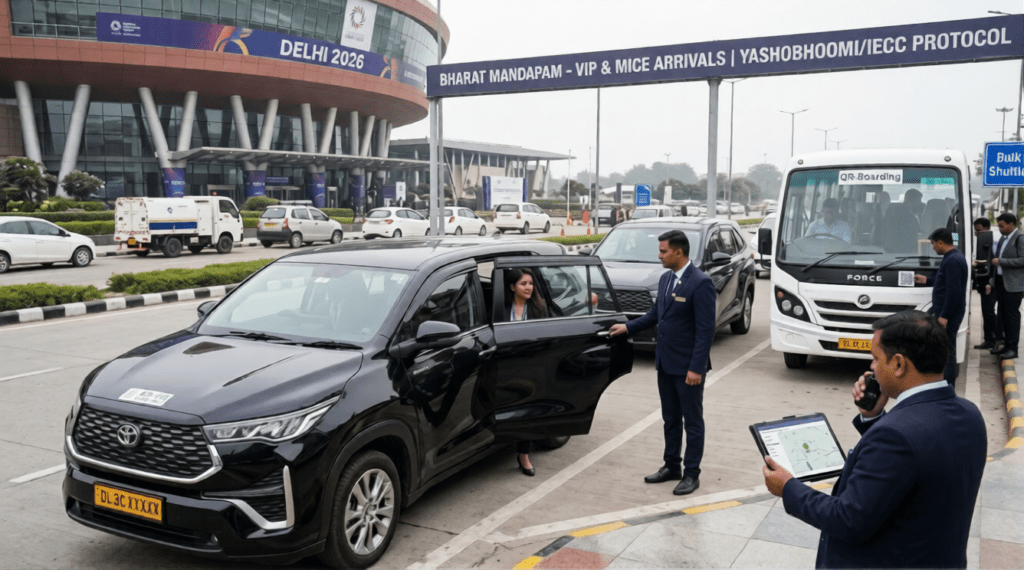
For international summits — the AI Summit hosted here in February 2026 being the most recent high-profile example — vehicle security vetting involves coordinated documentation with Delhi Police, SPG if applicable, and Ministry of External Affairs protocol teams. A transport vendor who does not know this process cannot be onboarded two days before the event.
OurCorporate Car Rental for summit contracts includes pre-event security documentation preparation, advance liaison with the venue’s security desk, and a dedicated fleet manager on-site for the duration.
India Expo Mart — Greater Noida
India Expo Mart in Greater Noida sits on the Noida–Greater Noida Expressway, 45–55 km from IGI Terminal 3. Trade fairs here — auto shows, industrial expos, textile exhibitions — run multi-day schedules with early morning setup and late evening breakdown.
The Expressway access is fast in clear conditions. But at 8 AM on a trade fair opening day, with exhibitor vehicles, delegate coaches, and freight transport converging from three access points, an uncoordinated fleet is a bottleneck creator. Our Expo Mart protocol includes staggered arrival windows per vehicle category and a holding zone management plan for the pre-entry queue.
Key Takeaway: Each venue demands a different approach plan. One transport SLA covering all three venues without venue-specific protocols is not a plan — it is a liability.
Section 2: Safety & Compliance — The Audit Layer Every Event Manager Must Cover
AIS-140 VLTD + Panic Button Compliance
As of 2026, AIS-140 Vehicle Location Tracking Device (VLTD) installation is mandatory on all commercial passenger vehicles operating in Delhi NCR under contract carriage. The device transmits real-time vehicle location to the state transport authority’s central server. Vehicles without a functioning VLTD are not legally compliant for event transport assignments.
The AIS-140 standard also mandates an integrated panic button in the vehicle. When pressed, it sends an emergency alert with the vehicle’s GPS coordinates to the nearest police control room and to the transport operator’s monitoring system.
For your event transport vendor, this means:
Every vehicle in the event fleet must carry a certified AIS-140 VLTD unit
Panic button functionality must be tested and logged before the event
VLTD activation certificate must be available for security verification at venue gates
Real-time tracking must be accessible to your event security team — not just the vendor
An event where a diplomat or senior government official is traveling in a vehicle without AIS-140 compliance creates a protocol failure and a potential security liability. This is not a theoretical risk.
OurChauffeured Car Rental Services for event and diplomatic assignments uses the same three-layer BGV protocol as corporate contracts:
Layer
Verification
Source
✅ Layer 1
Police character certificate + address verification
Local police station
✅ Layer 2
Criminal record check
Registered third-party BGV agency
✅ Layer 3
Driving licence validity, endorsements, suspension history
RTO portal
For diplomatic and government protocol events, driver details — including VLTD vehicle registration and BGV certificate copies — are submitted to the event security desk 72 hours before the event. Not on the day. Not the evening before.
Key Takeaway: AIS-140 compliance and driver BGV are not vendor value-adds — they are the legal and security floor. Any vendor who cannot confirm both in writing before the event date is not operationally ready.
Section 3: Fleet Specialisation — Matching Vehicle to Event Role
Not every vehicle is right for every event function. Fleet selection should match the requirement, whether it is Conference Transportation, Delegate Transportation, Corporate Event Transport, VIP movement, or wedding guest transfers. Using a Fortuner for a shuttle loop, or an Urbania for a VIP protocol run, creates operational friction and cost inefficiency.
Event Role
Vehicle
Capacity
Why This Vehicle
VIP / Protocol movement
Toyota Innova HyCross
6–7
AIS-140 compliant, ESG-reportable CO&sub2;, professional cabin.
High-volume events — 500+ delegates across multiple sessions — cannot rely on manual driver-to-passenger matching at the exit. It creates queues, delays, and security issues.
Our Force Urbania shuttle fleet uses a QR-based boarding system:
Each delegate receives a unique QR code at registration (or on their event app)
The shuttle driver scans at boarding — confirms seat allocation, destination, and identity
The fleet manager’s dashboard shows real-time occupancy per vehicle
Departure is triggered when vehicle is confirmed full or the time window closes — not when the driver decides
All boarding data is logged — available for post-event headcount audit
This is not a premium add-on. It is the correct operational standard for any event above 200 delegates.
AI-Optimised Fleet Dispatching
Delhi’s 2026 traffic patterns — construction on the Dwarka Expressway widening, signal-free corridor projects on NH-48, and the ongoing Outer Ring Road junction upgrades — make static route planning unreliable.
Our dispatch system uses AI-based traffic integration to:
Re-route active vehicles in real time based on live traffic data
Predict bottleneck windows at venue exits (Yashobhoomi south gate is peak-congested between 5:30 PM and 7 PM on event close days)
Stagger vehicle release to prevent convoy pile-up at a single exit point
Generate ETA alerts to the event coordinator’s dashboard when any vehicle is running behind SLA
The practical result: a delegate corridor that closes at 6 PM has vehicles cleared from the venue by 7:15 PM rather than 8:30 PM.
Key Takeaway: Fleet specialisation and QR boarding are operational necessities for MICE events above 200 pax — not luxury features.
Section 4: The Financial & ESG Edge
GST Optimisation — SAC 9967 for Event Transport Contracts
Event transport contracts structured under SAC 9967 (Passenger Transportation — Contract Carriage) at 12% GST under Forward Charge Mechanism (FCM) give the event organiser or the sponsoring company full Input Tax Credit recovery.
The math:
12% GST paid on event transport → 12% ITC claimed → Net GST cost = ₹0
For a corporate event with ₹15 lakh in ground transport spend, the ITC recovery is ₹1.8 lakh — recovered in the same billing cycle, not written off as an event cost.
This requires:
Vendor must be GST-registered — verify GSTIN before signing
Invoice must be under SAC 9967 with IRN e-invoice for amounts above the threshold
Duty slips per vehicle per trip — the operational audit trail for your accounts team
GSTR-2B match — your ITC claim is auto-populated, no manual reconciliation
An event transport vendor who issues a non-IRN invoice, or is not GST-registered, costs you the full GST amount as an unrecoverable expense. On ₹15 lakh spend, that is ₹1.8 lakh left on the table.
ESG & SEBI BRSR — Green Event Certification
For listed companies hosting corporate events, the transport fleet is part of your Scope 3 Category 12 emissions (downstream leased assets and third-party services) and intersects with Category 7 (employee commuting) for staff attending the event.
Vehicle emission comparison for event fleet selection:
Vehicle
Fuel Type
CO&sub2; per km
vs Diesel Baseline
Diesel Innova Crysta
Diesel
~235 g/km
Baseline
Toyota Innova HyCross
Strong Hybrid
~188 g/km
~20% lower
Electric Vehicle
Electric (India grid avg.)
~60 g/km
~75% lower
Replacing a 20-vehicle diesel event fleet with Toyota Innova HyCross for a 3-day conference (average 200 km per vehicle per event day) saves approximately:
(235g – 188g) × 20 vehicles × 600 km = 564,000 g = 0.56 tonnes of CO₂ per event
Across 10 corporate events per year: 5.6 tonnes of measurable CO₂ reduction — reportable under SEBI BRSR Scope 3 disclosure.
What we provide for green event certification:
Per-vehicle, per-day CO₂ data for the event duration
Fleet emission summary report — usable in event sustainability reports and BRSR disclosures
PUC certificates for all vehicles — available to venue sustainability coordinators on request
HyCross fleet percentage report — for green event certification applications
Key Takeaway: SAC 9967 FCM billing recovers 12% GST as ITC. A hybrid fleet reduces Scope 3 event emissions by 20–75%. Both have a number attached. Neither is discretionary for a listed company running corporate events.
The most critical logistics window for any Delhi NCR event is the 6-hour arrival cluster at IGI Terminal 3. International delegates from 15 cities on 12 airlines landing between 6 AM and 1 PM — with hotel check-in at Aerocity or Connaught Place, and a 10 AM opening session at Bharat Mandapam.
This is where uncoordinated transport fails completely.
Meet & Greet at T3 arrivals: Uniformed chauffeur with event-branded name board at the international arrivals exit
Flight tracking per delegate: Each vehicle assignment is linked to a specific flight — no driver is dispatched until the flight has landed and baggage belt is confirmed
VLTD + AIS-140 compliant vehicles — passes diplomatic and government security checks at Bharat Mandapam and Yashobhoomi gates
Real-time coordinator dashboard: The event transport coordinator sees every arrival vehicle, ETA, and delegate status on a single screen
No surge pricing: Fixed per-transfer rate confirmed before the event — regardless of flight delay, traffic conditions, or time of arrival
For events with 50+ delegate arrivals across a single day, we assign a dedicated arrival fleet manager at T3 — separate from the venue-side fleet coordinator.
Key Takeaway: Guest arrival is the first physical impression of your event. A delegate who waits 40 minutes at T3 because the driver went to the wrong terminal has already formed a view of your organization’s operational competence.
Section 6: Outstation Events — Destination Weddings and Corporate Retreats
Delhi is the origin point for India’s most active destination event circuit — Neemrana Fort, Jaipur heritage properties, Agra Taj convoys, and Rishikesh retreat venues all draw Delhi NCR corporate event traffic.
Our Outstation Travel Services support Wedding Transport and corporate event movements for destination events:
Fixed-route fleet contracts: Delhi to Jaipur (270 km), Delhi to Agra (210 km), Delhi to Neemrana (122 km) — fixed fare per vehicle, confirmed before event
Multi-day driver assignment: Same driver, same vehicle, for the full retreat or wedding duration
Overnight driver allowance: Included in the outstation rate — no last-minute renegotiation at the venue
Convoy management: For weddings and corporate retreats moving 10+ vehicles on the same route, we manage departure windows, highway rest stops, and arrival sequencing at the destination
For destination weddings at Neemrana Fort Palace or Dera Amer Jaipur, vehicle movements span 3–5 days and involve a combination of guest airport pickups, city hotel transfers, fort approach convoys, and return Delhi drops. This is a fleet management exercise, not a cab booking.
Frequently Asked Questions
Q1: What is the peak season for event transport demand in Delhi NCR?
The primary peak runs October to March — the diplomatic season, winter conference calendar, and pre-summer corporate events cycle. February is the single highest-demand month, driven by international summits (including the AI Summit at Bharat Mandapam in February 2026), auto industry events at India Expo Mart, and the pre-budget corporate meeting cycle. Book event fleet resources minimum 3–4 weeks in advance for any event above 100 delegates during this period. Last-minute fleet procurement in February in Delhi NCR is a logistical and pricing risk.
Q2: Is AIS-140 compliance mandatory for all event transport vehicles in Delhi NCR in 2026?
Yes. AIS-140 VLTD (Vehicle Location Tracking Device) is mandatory on all commercial passenger vehicles operating under contract carriage in Delhi NCR as of the 2026 regulatory framework. The device must be certified, active, and transmitting to the state transport server. For events at Bharat Mandapam and Yashobhoomi involving diplomatic or government delegates, security teams at the venue gate will verify vehicle registration and VLTD activation status. A non-compliant vehicle will not be permitted entry to the protocol vehicle zone. All vehicles in our fleet are AIS-140 certified.
Q3: Does Yashobhoomi have Metro connectivity, and how does it affect transport planning?
Yes. Yashobhoomi Dwarka Sector 25 station on the Airport Express Line provides direct Metro access to the venue. For events where a large proportion of delegates are staying at Aerocity hotels (New Delhi Airport station on the same line), Metro movement for general delegates is viable — cutting surface vehicle requirements by 30–40% for that segment. The Metro connection does not eliminate the need for surface vehicles; it changes the fleet composition. VIP, protocol, and mobility-impaired delegate movement still requires private vehicles with dedicated drivers. Our event plans incorporate the Metro connectivity model as a standard cost-reduction lever.
Q4: What is the GST treatment for event ground transport, and can the sponsoring company claim ITC?
Event ground transport contracted under SAC 9967 (Passenger Transportation — Contract Carriage) at 12% GST under Forward Charge Mechanism is fully ITC-recoverable by the registered sponsoring company or event organiser. On ₹15 lakh event transport spend, the ITC recovery is ₹1.8 lakh. This requires an IRN e-invoice from a GST-registered vendor. Duty slips per trip complete the audit trail. An unregistered vendor billing without GST costs you the full tax amount as an unrecoverable event expense.
Q5: How does the QR-based boarding system work for large delegate shuttles?
Each delegate receives a unique QR code — either printed on their event badge or sent to their event app at registration. On boarding the Force Urbania shuttle, the driver scans the QR code at the door. The system confirms seat allocation, destination, and identity against the pre-loaded delegate manifest. The fleet manager’s dashboard shows real-time vehicle occupancy. Departures trigger on confirmed full capacity or at the scheduled window — not on the driver’s judgement. All boarding records are logged for post-event headcount and security audit. This system eliminates the manual matching queue that creates the 20-minute delay at shuttle exit points on high-density event days.
The Operational Conclusion
Event transport in Delhi NCR in 2026 is a compliance, technology, and logistics problem — not a car procurement exercise.
The venues are world-class. The delegate expectations are international-grade. The regulatory requirements — AIS-140, BGV verification, IRN e-invoicing — are non-negotiable. And the financial case for getting the vendor structure right (SAC 9967, FCM, full ITC recovery) is measurable in lakhs, not percentage points.
A vendor who cannot confirm AIS-140 compliance, driver BGV certificates, and IRN e-invoicing capability before you sign the event transport contract is not a logistics partner. They are a risk item on your event brief.
Data points regarding AIS-140 regulations, SEBI BRSR Scope 3 requirements, and GST SAC classifications are based on current regulatory notifications and industry practices as of April 2026. Verify applicability with your legal and compliance teams for specific event requirements.
Event Transportation Guide — April 2026 | Delhi Airport Transfer | AIS-140 Certified Fleet | BGV Verified Chauffeurs | SAC 9967 FCM Billing | IRN e-Invoice Compliant | SEBI BRSR Scope 3 Data Available
Hello! Welcome to Delhi Airport Transfer 🚗
Looking for a reliable ride? Let us know how we can help you with your booking today!
By clicking the chat button, you agree to receive booking updates and car rental information from Delhi Airport Transfer via WhatsApp. We respect your privacy and will never spam you.
 Key Takeaway: Each venue demands a different approach plan. One transport SLA covering all three venues without venue-specific protocols is not a plan — it is a liability.